
UI Collab, in partnership with Gardner Innovation Search Partners and Higher Talent, works with leading organizations across academia, industry, and government offering executive search services and recruitment for roles that support research, innovation, and university–industry collaboration.

Are bonus structures the key to driving success in university technology transfer offices? Or do they pose more challenges than benefits? Join us for a dynamic and interactive discussion as we explore whether bonuses and similar incentive programs can be effective motivators in technology transfer and commercialization offices.
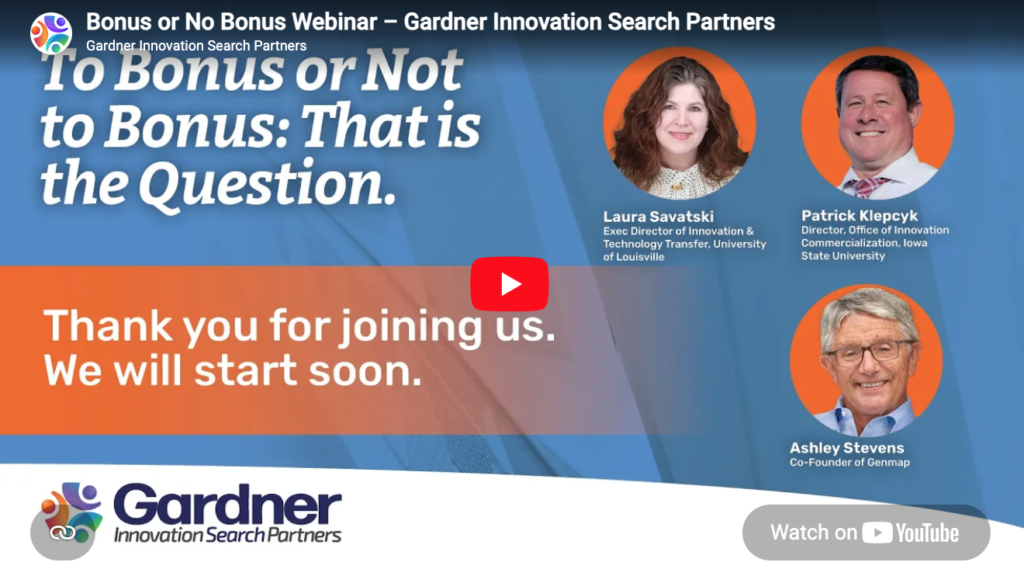
In this webinar, panelists Laura Savatski, Ashley Stevens, and Patrick Klepcyk will dive into the pros and cons of bonus programs, share real-world examples from their own experiences, and discuss creative ways to incentivize teams when traditional bonus structures aren’t an option. With live audience participation, you’ll have the opportunity to weigh in on the conversation, share your perspectives, and learn how other institutions approach employee incentives.
Whether you’re leading a tech transfer office, interested in starting a bonus program, or simply curious about best practices in motivating teams, this webinar will provide valuable insights and actionable takeaways.
Key Topics:
- The advantages and potential pitfalls of bonuses in tech transfer
- How to design a bonus structure that works for your team
- Creative alternatives to financial bonuses
- Best metrics for evaluating performance and incentivizing the right outcomes
UI Collab is a consulting and talent solutions firm focused on advancing university–industry collaboration. We offer executive search services to help organizations across academia, industry, and government build high-performing teams that drive research, partnerships, and commercialization forward.
Keep an eye on our Open Jobs; you never know when something will come along that fits your qualifications and expertise! Search our open job listings.
Interested in our executive recruiting solutions? Our expert consultants are skilled at working with teams to define role scope, align stakeholder expectations, and manage a structured search process designed to identify candidates positioned to strengthen research translation and ecosystem performance. Let’s work together!
Full Webinar Transcript
Quentin Thomas: Hi, everyone, and welcome to today’s webinar to bonus or not to Bonus. That is the question. My name is Quentin Thomas, and I am your host for today’s webinar. Thank you for joining for another insightful session, specially tailored tailored for technology transfer leaders interested in bonus programs and structures in their offices.
In today’s webinar, we are exploring how bonuses and similar incentive programs may or may not be effective motivators in technology transfer and commercialization offices.
Our panel will share their experience and insights on the advantages and potential pitfalls of bonuses in tech transfer. designing a bonus structure and metrics for evaluating performance and incentivizing the right outcomes. This will be an interactive session. So before we begin, I’d like to quickly share a few tips on how to get the most out of today’s session. At the end of our discussion there will be a live Q&A use. The Q&A feature at the bottom of your zoom window to submit your questions throughout the session. We may not get to all of your questions, but we will do our best. We want this session to be an opportunity for you to learn from one another as well as our panelists, so we’ll be looking to you our attendees to also share your insights as well.
Throughout the webinar. There will be opportunities for you to share your own experiences and insights through a few polls. We encourage you to share additional thoughts and engage openly in the chat with one another. Jeff Bond, from chat with leaders. Media is serving as today’s engagement director, so he will be active in the Zoom chat.
Speaking of polls. No, this is not an election thing, but we are going to give everyone a quick, warm up, Poll, and then jump right into this 1st poll. All right, so we can go ahead and launch the 1st poll. The question is. if you could receive a bonus for one of the following achievements in your office. which would you choose at surviving back-to-back meetings with ease, coming up with the year’s best coffee brew in the office, mastering the art of interpreting legal jargon, finally emptying your email inbox or winning the unofficial office snack off competition.
Me. Personally, I’m definitely a snack person, so I’d probably say the snack off one alright. I think that is about well, I’ll give it just a few more seconds. Alright cool, I think, and, Jeff, we can go ahead and show the results for it. Alright. So I don’t remember who it was. I think it was Glen before, when beforehand, was saying that he thinks that the email will win. But email definitely won. But mastering the art of interpreting legal jargon was a close second. So thanks everyone for participating in this poll like I said, there will be a few more throughout the session as well, too.
So as we move on prior to this webinar, we also send out a survey on bonus structures and technology transfer. We’re excited to share the results with you. We’ll move quickly through the results. Hear me. We’ll move quickly through the results and speak in more details throughout the webinar. But don’t worry. You’ll also receive a summary of the results from our sponsor gardener innovation search partners after the webinar.
So let’s jump into the survey results. So for the 1st question out of 48 respondents, only 9 said that they have some form of bonus structure in their office right? And then out of those who did have an incentive program of some sort. The majority said, they are performance based, including 2 people who said it was performance based, one combined with stay and the other combined with retention bonuses, and then oh, sorry stay or retention bonuses, and the other being combined with profit sharing. and amongst those offices that do have bonuses most said they are individual bonuses. There were a couple of team bonus, or both structures of combination of individual and team. and then, out of those who do those offices who do not currently have a bonus program.
The number one reason was a lack of approval from administration, but that was followed by budgetary constraints and a lack of necessity. We also got some additional responses as well. and out of those additional responses, for reasons that there’s not one. The top reason was concern about fairness or concerns, about incentivizing the right behaviors and then state regulations as a public institution. So there are, of course, a lot of public institutions here joining here, so can understand. That may be a concern.
And then the next question, What are the top 3 metrics offices use evaluate technology transfer success the top 3 from the choices that were available were number of licenses, number of disclosures then licensing revenue. But we also saw responses such as products and services on the market or the product being available to the public. And then, when you dig a little further into the responses. You see that offices are also looking at qualitative measures not just quantitative. So we had some responses such as whether inventions are being used in responsible ways, and the one that was most common was customer satisfaction which I’d be really interested seeing some information in the chat.
A few of you don’t mind sharing how exactly you’re measuring customer satisfaction, because there’s a lot of ways you can do that as well, too alright. And then, when it comes to what we see as the biggest challenges budget constraints came out as Number one choice for why, they were the biggest challenge for launching it, but that was again was out of the choices we had available in the survey. If you dig a little deeper into the the big picture here you get a little bit more details. And so out of the other responses.
One response summarized many of those answers. Well, in saying, the biggest challenge is the unintended consequences of metric based compensation amongst the response. Those responses. We also found competition amongst managers for what they would consider to be the best technology coming across as a commission and creating conflicts and negotiating in good faith where the licensing manager could be perceived as negotiating what is the best for them as opposed to for the technology or the organization.
and then the other one was ethical concerns, whether that be perceived concerns or actual ethical concerns. and then to round this out the question, what non-monetary incentives have been most effective in motivating technology transfer professionals? This was a free form answer, and some common responses were received, including work-life, balance, and professional development. But the clear number one here was recognition.
At 1st this surprised me, because, coming into this webinar, I’m thinking about bonuses and monetary incentives. But given the work we’ve done at chat with leaders media and helping elevate cultures and team engagement within organizations. We’ve also seen these themes again and again in the past couple of years. I’m sure it will continue to come up in many conversations, and I’m definitely looking forward to diving into this conversation. but before we jump in. I’d like to take a moment to thank our sponsor Gardner Innovation Search Partners for their support in making this webinar possible. Now I’ll pass it over to Glen Gardner to share a little bit about his organization and introduce himself before we introduce the rest of the panelists. So, Glen, over to you.
Glen Gardner: Happy Halloween. I came as a headhunter. This is how we club the people out in the tech transfer community to to bring them to to some of our our clients. I wanted to thank you guys for for joining this. This came about for from a conversation with with a person in our community. They wanted to know about bonus and no bonus structures.
Which is why why we’re having this. We’d like to thank all all the people that have joined us to put this together. We’d like to to thank. Thank thank you all for for for attending this. And I’m I’m really humbled that people came from all out all around the world to tune in. And some of our partners in Australia where we’re gonna send this recording to them after.
And if there’s 1 thing you could do for your trick or treat for me, if you could go to Gardner, the our LinkedIn page for gardener innovation, search partners and follow us. That would be the price of admission. So thank you, guys for for all joining us.
Quentin Thomas: Awesome, thanks Glen.
Glen Gardner: Back to you, Quentin.
Quentin Thomas: Yup. and so now I’m happy to introduce the rest of our fantastic panelists, Laura Savatsky, Patrick Klepsick, and Ashley Stevens. I’ll start by handing it off to you, Laura, so welcome, Laura.
Laura Savatski: Well, I don’t have a bone to pick with anybody, but I’m a big fan of Halloween, that’s all you get for my costume this year. I’m really happy to be here, really excited to be talking about bonuses and bonus structures. I think they’re a very important part of work life for some people, and they’re completely absent for others.
And we’re going to talk a little bit more about that. My background started as a bench scientist in medical research. I worked for a medical college where, though we didn’t have a bonus structure, we did have a very rigorous annual review, and that was tied to raises and your climb up the ladder from from there I worked for a startup where we didn’t have any money to give any bonuses, so those bonuses were in the form of stock in the company which did pay off for me eventually, but it took quite a while from there I went on to work for a research institution, and it was a private research institution, a not for profit.
Where we did have a bonus structure. I’m going to talk a lot more about that later. And now I’m working at University of Louisville. where we don’t have a bonus structure in place, currently. And that’s what we’re here to talk about today. My my background also includes some leadership positions within AUTM on the AUTM board, etc.
Etc. Happy to be here over to you, Ashley. I can’t wait to see your costume.
Ashley Stevens: Oh. well, you’re not going to. This is me. I I’ve been retired from Bu for about 12 years now, but still professionally active through the focus IP group, where the group is a slight exaggeration. It’s a a 1 man company. So my involvement in bonuses, I I’m sorry to say, is purely theoretical. I have never been with a company that had a bonus structure in my life.
I started out with the Procter and Gamble company which did have bonuses, but I was with a very young and fast growing division, and when they had had bonuses before I joined, you know that they hit the maximum every time, and this irritated all the other groups that didn’t hit the maximum every time.
So we just didn’t have a a bonus structure in the Industrial Chemicals division as with Laura when I was with startups by biotech startups your stock ownership was your bonus. and I made a little bit out of the 1st one, and the second Share certificate is framed on my wall, which is never a good sign.
and then neither at Dana Farber, Cancer Institute, nor at Boston University have we had bonuses. I have. I was involved in some of the early days of when bonuses started to be discussed in workshops at the Auto Manual Meeting. With Fred Reinhart, and I think Fred took over the running on that for quite a while.
So I’m delighted to be here today to participate in the discussion over to you.
Patrick Klepcyk: I don’t. I don’t think so. So I, too, am excited to be here. And similar experiences. One of my 1st positions was with a startup based on university technology over 22 years ago, and that got me interested in this interface. I spent some time with Gsk. R. And D. China. We did have a bonus structure.
But the main reason I’m here is some experience at the University of Virginia. The licensing Adventures Group, or formerly the Patent foundation. So when I was a director of licensing there, we launched incentive compensation, if you will. I think we we didn’t like to call bonus structure. It mainly grew out of the fact that our executive director was the only one getting a bonus, and so the desire to reward the licensing team for the same metrics that aligned with with his bonus structures is really how that came to be performance to budget disclosures and deals, and that grew over time to even expand into some of the support.
Groups as well. A little bit background on myself, you know. You can see the slide here. But I’ve been in tech transfer for about 20 years. I’ve been at Iowa State as a director of Office of Innovation Commercialization and the president of the Iowa State University Research Foundation for about 3 years was also at the Cleveland Clinic Case, Western Reserve University and National University of Singapore.
Back to you, Quentin.
Quentin Thomas: All right. Awesome, thank you. And just a quick introduction of myself. My name is Quentin Thomas. Even though I’ve been talking to you all this time. I’m 1, a co-founder of chat with Leaders Media, along with my business partner, Jeff Bond, who’s our experience? Lead in the chat with you all today.
At chat with leaders, we create compelling podcasts, live events and content strategy for purpose, driven companies specializing in connecting these organizations with their core audiences who are their people and customers through engaging and meaningful content. I actually started my career in tech transfer as a fellow at the University of Florida office of Technology licensing and I started at.
Then I served as the marketing manager in the office of Technology Transfer at Emory University, then transition into industry in a customer success role and at a software company called Infotech. And now I found myself coming full circle back to Tech, transfer through my own company now and also working with Glen and the great Gartner Innovation Search partners, team as the host of the Gartner, innovation, search partners, podcast so with all of that being said, how about we just go ahead and dive into our discussion today? So the 1st thing we’re going to do to kick off is open up with another poll.
So this poll that I have we have. And Jeff, actually, you can go ahead and put up the the next poll. So for this one, the question is, does your office currently have a formal bonus or incentive structure? Yes, no. Or maybe you’re considering it. and I’ll just give it a few seconds. You all are pretty quick on the polls.
Good! Alright! I think we can go ahead and call it here and share the results. So it looks like 12 of you currently have a a bonus or incentive structure of some sort. Most of you do not 63%, 34. And then a few of you are actually considering it. So hopefully during this webinar today. We’ll help give.
maybe clarity, maybe a little bit of insights into it. So 1st thing, lets I’m going to actually ask the 1st question, and I’m going to kick it off with Patrick. So Patrick, can you share any examples of? And actually, you started to a little bit in your intro. And so I want to start with you some examples of successful bonus programs you’ve encountered, or in the converse.
What specific elements have you seen or sorry, or what specific elements you’ve seen work effectively in practice?
Patrick Klepcyk: Yeah. So I think little bit more details on UVA’s program. What was successful was that it was both individual and team based so you could still meet your individual goals. But the entire office had to perform the budget, or else the other 2 components weren’t available to you. There was a little bit of the recognition piece slash, slash quality component, and that that came into your your individual as well.
So that was at my discretion. You know, somebody had a really good year, and the other 2 categories are really, you know, customer service oriented good faculty relationships. I had some discretion with still giving them their full amount. Even if they didn’t meet their individual numbers. But it it took a lot of work to split up and forecast the deal number.
you know, one person focused on really our tangible material portfolio so she might have been doing about 20 deals. and then maybe someone else was more focused on startups or you know, they weren’t. They were doing maybe 5 ish. And so I I think it was a really good team effort, and we were able to, you know, keep people motivated as we continued to to hit our numbers.
And then, when that when that expanded to other support staff into, you know, error messages for I, Edison, a reduction in those we also had unique set up at UVA, where we had 2 in house patent attorneys. And so their bonus structure was based on the number of conversions and or provisionals that they forecasted to do that year.
So it was really quantitative in nature for the most part.
Quentin Thomas: Yeah. And then, Laura, could you share a little bit about your experience with bonus programs or incentive programs?
Laura Savatski: Sure. So I worked at the Blood Research Institute for almost 25 years, and for approximately the last 10 or 12 years of that we did have a bonus structure that was implemented. And, Patrick, you hit on something. That word motivated. And I think for us we had a similar structure in that the organization had hit its overall financial goals, or we couldn’t afford to pay out these bonuses.
And so the Board had to approve payment of bonuses, and then your department had to meet its financial goals as well. And then you needed to meet your personal goals. So those personal goals were set every year in your annual review. and you they really help to keep people motivated and on track to meet very specific goals.
What I liked about the bonus structure is that you know it did promote teamwork for us because there was a departmental component. There wasn’t competition with other people. It was more of a. We want the entire team to succeed, because if they don’t, we’re not going to get this bonus, and then I need to meet my individual targets, too, or I won’t get a portion of my bonus.
I think the other thing that made it really work there is that it was systems wide. Everybody was eligible for a bonus, so there was a certain bonus level available to managers that wasn’t available to to part time staff or to regular staff. but everyone had a bonus available to them, and they were.
They were just different by some, some small amounts. But I really liked the fact that it kept people motivated and on task. It helped me stay motivated and on task with what my goals were, and it it made me a better employee. I thought.
Quentin Thomas: Yeah. you know, talking about staying motivated on task. I mean, I think one of the things that really came out during the survey a big thing came out during the survey is this thing of motivating the right or wrong behavior. So I’m actually pivoting a little bit. And just so everyone knows I do have questions here that I want to ask.
And I’m gonna jump around a little bit because just the order of things here and as a matter of fact, I think and give everyone a second with answering this. what do you think is an effective incentive for motivating people in a tech transfer office, because in the survey we saw some people saying that you’re going to motivate people to do to serve their own interests, or, you know, not necessarily the best interest of the technology or the organization.
So if you don’t mind, let’s jump into that. Since we’re talking about motivation. And and, Jeff. I’d also say, during this time you can go also. Go ahead and post that poll. Question number 5 of in your opinion, which is the following most effect is the most effective incentive for tech transfer offices.
and so I’ll give you all a second. But yeah, Laura, sounds like you were. Gonna say something.
Laura Savatski: I can take that question. I think I think you have to be very careful with what the individual goals are that you set, and then because they can be gamed fairly easily. So one year I had increasing our total number of disclosures by 25%. Our disclosures had been low the previous year. So we wanted to get them back in line.
So I thought, Oh, it’s gonna be a great, a great target to increase disclosures, and what I saw by doing that, even, you know, for myself, was that I was very motivated to hit that number. But as everyone in the audience knows a disclosure is not a disclosure, is not a disclosure that you can have some really crummy light disclosures, and you can have some really fulsome quality disclosures that you know are going to turn into a great product for the market.
And so, just by, you have to be careful in which goals you pick because people are are motivated by those measures. And they you do have to be able to to quantify whether or not somebody hit this this number or not, because if you have a qualitative thing there, you’re just gonna have arguments, and people are going to argue with their supervisor about whether they hit it or they didn’t hit it.
And that’s like the worst thing you could do within the the the realm of having a bonus because it’s supposed to be a positive experience, right? It’s not supposed to bring people apart and and cause division. It’s supposed to be a positive thing that you’re doing. So you want to have have it defined very, very clearly whether you hit it or you didn’t, or for both the employee and the supervisor.
Who’s then going to approve the little check box? Yes, they did it or no, they didn’t.
Ashley Stevens: And of course, Laura, by getting a disclosure, you are creating an expectation in the mind of the researcher who submitted it, that something’s gonna happen with that disclosure, so you can up your disclosures, but you better be ready to up the activity to attempt to market them and license them.
Patrick Klepcyk: Yeah, I mean, we found that They were inflated disclosure numbers in full transparency. And so when I came here to Iowa State. you know, it was like, we then began to measure UVA. What are the actionable disclosures? And so just using some round figures? If we were getting 200, maybe really only a hundred were worth time and effort.
And then that does put pressure on the system. for you know, internal folks from compliance and and reporting, and things like that so completely agree that some of those numbers can be gained. And you know, just like, Are are you doing free options, or, you know, minimal $1,000 payments per option to get it count for a deal.
You really got to stay on top of, you know. Clarity with the numbers.
Ashley Stevens: Yeah, and who determined whether they were actionable or not.
Patrick Klepcyk: What’s that?
Ashley Stevens: I said, who determined whether they were actionable or not.
Patrick Klepcyk: Let’s say, enabled.
Quentin Thomas: Yeah, and and, Jeff, you can go ahead and end that poll and show the results. And we’ll continue to to discuss this this topic as well, too. Yeah. So the the audience is saying that, well, number one is financial bonuses number 2, flexible work arrangements number 3, public recognition. It’s interesting, because in the survey I saw a lot of public recognition come up in the survey, and I think, Laura, you were talking about how, if you’re going to put some metrics in place.
It does need to have some sort of quantitative or measurable aspect to it, because otherwise it’s gonna be a lot of arguing right? And like you and Patrick are talking about here. So yeah, I’m curious. Well, it will just to also leave some some space as well, too. When it comes to actually having those metrics and and putting them in place and enforcing them like, how how do you? Because, Patrick, actually, I’m gonna go to you.
One of one of the things you mentioned was what Ashley was asking about like, how do you determine whether or not, that is is a a actionable disclosure. Right? so so whenever you do have metrics that are in place, that to some may seem a little more qualitative. Are there guardrails, or are there ways that you address that? And and just to kind of give you an idea of where I’m going with it, too.
In the survey. One of the things people talked about was customer success, and some of them said the way that they get it. And you know, customer success seems subjective. But one of the ways they got around that is using, like maybe a a 5 point scale with their the their inventors as well the pis. So any any thoughts about that?
Patrick Klepcyk: Yeah, I mean, I guess if I was to criticize some aspects of the program to Laura’s point, it’s supposed to be a positive experience, but I did find that that often you are looking at poor customer service feedback in order to give less of that qualitative piece. And so, if I was being self critical for my experience at UVA that didn’t come into play all the time, but that just sprung to mind with with Laura’s comments as opposed to, you know.
very proactive, positive momentum of here’s. you know, 5 faculty members that gave kudos emails and then rewarding that it was usually looking at where people had ways to improve, and so that that might have left a bad taste in people’s mouths.
Ashley Stevens: And of course, part of the problem is that we only license about 3 quarters of the invention disclosures we get, you know, about half of the new patent filings we make. So you know, 3 quarters of faculty. You’re telling them their baby is ugly and nobody wants it, which is never a message that people want to hear, and that can probably factor into customer satisfaction surveys.
Quentin Thomas: And and what are your thoughts about things? So I’m just pulling out some more more things that we heard from our audience in the Pre survey, too. What, each of you? What are your thoughts about things such as you know, industry engagement? I know that people talked about. Okay, you know, licensing revenue number of license disclosures.
But there was also things like industry, engagement or getting products into the market, or one person even said. Actually seeing products that are. you know, being used by people impacting lives like having a metric like that, where you can actually see things like that. What are your thoughts about those pros? Cons to those? Are there other things that you think would be better, or even in the inverse? Are there things you think are just terrible metrics to use as well.
Ashley Stevens: Well, I think license income and to a certain extent products launched is our terrible metrics. Because, they are typically the result of things that were done 10 years ago, and probably the person responsible is long gone, and they ain’t gonna get compensated for their work and somebody else. No is standing on on their shoulders and getting the benefits.
So I think those 2 are absolutely terrible metrics. I I think what? Probably one of the benefits of working with your institution. To create a bonus structure is going to be. It’s going to force the institution to really decide what it wants from you from the Tech Transfer office. And we know that that the the senior management, different people have different perspectives.
The vice president for research, you know, wants faculty satisfaction. The Vice President for finance wants money the general counsel wants no issues. So I think. coming up with a bonus structure. Top management is going to have to come to agreement on what it really wants from this function, which I think means it could take quite a long time to get one set up if you don’t have one.
Laura Savatski: Yeah. And that’s really interesting. You mentioned that Ashley? At the Blood Research Institute, where I was, where we had this very, I thought, very well designed bonus structure. The goals of everyone were public, and they flowed down. So we had this whole process where the CEO had to set her goals first, st and then, after she set her goals, all of the Vice Presidents set their goals to support and aid one of her goals, which were all the strategy for that.
Her goals were all aligned with all of our strategic initiatives for the for the year, and so now the VPs had to set their goals in support of hers, which were the strategic initiatives. And then the people that reported to those Vps. As you went down a couple of more layers. They all had to support something that was a goal of their business unit, their leader, etc.
So it was. It was a very well thought through design, and what it got us to was really focused. You know, a really focused approach, and not just. you know, shooting things in the dark like. I just want more invention disclosures. You asked about earlier Quentin industry engagement from the audience.
And what would a measure be like? I actually had one of those goals one year. It was the number of confidential disclosure agreements that we inked, or an agreement that had confidential disclosure, language within it with a new industry partner. So we were we were looking at. You know. How well am I engaging new people that we’ve never engaged before, and having a serious conversation about licensing a tech.
Now, did all of those result in licenses? No, but you have to do a combination of sort of shots on goal and goals that you get, because you’re never going to get a goal unless you make a shot on goal. And so you’ve got to incentivize the behaviors that are going to lead to your wins, but not necessarily the end.
Win in the very beginning, because you, you need to have a trajectory to follow.
Ashley Stevens: I mean one of the principles of the Hr. Profession is, be careful of what behavior you incentivize, because you will get it so. One of the sad stories I recall hearing of years ago was that when the University of Chicago and Argonne National Labs set up arch development they wanted it to get to break even as fast as possible.
Somehow, tech transfer offices are held to different financial standards than other administrative offices of the university. So they gave a bonus for getting to financial Breakeven. Well. if you want to get to financial break, even, how are you going to do it? You’re going to license stuff fully paid up upfront.
and those of you who’ve taken my valuation course know I have those 2 inversely correlated curves, you know, risk going down and value going up. So you do your fully paid up license. You’re doing it at the beginning, when the values lowest and they got to break even. And when, years later, they went back and said, Well, what would have happened if we’d done? You know more traditional licenses, they said, holy Mackerel, look how much we we gave up.
So be very careful what behavior you incent, because you will get it. That’s why I say, you know. the exercise of creating a program will really force the institution to decide what it wants.
Quentin Thomas: Yeah, that’s great both of you. And a great example, you know. Kind of going off of that. I think we can go ahead and launch the poll. Number 3 as well. So the question of that one was, What do you believe is the biggest challenge in implementing a bonus structure. And actually, I’d love to go to each one of you, too.
If kind of going off. What you’re talking about right now, you know, incentivizing and incentivizing the right behavior. If you incentivize the wrong behavior. it’s your fault, I mean, you incentivized it right.
Ashley Stevens: Yeah.
Quentin Thomas: And I think there, there, yeah, I think there is a challenge with I do love the idea, Laura, of what you shared of the the top down goal setting because it ensures everyone is in alignment. But then, at the same time, you do run into this challenge, one challenge where, people may not necessarily agree with the direction the leadership wants to take it right.
Laura Savatski: Too bad! That’s their leader. Get in line.
Quentin Thomas: Yeah.
Laura Savatski: That was that was that. And, in fact, that’s what the the bonus structure instilled. You know, people to get in line behind the initiatives rather than doing something extraneous, and that has its pluses and minuses. I I thought it was mostly pluses because we stayed focused. And when you have focus, you’re able to accomplish something.
Ashley Stevens: But the blood center. Laura was really kind of a not-for-profit operating company. Wasn’t it much more than a uniform.
Laura Savatski: It was a not for profit that had some very large divisions within it that operated much like industry and for profit companies. It’s also it’s also an approximately 1 billion dollar company. I mean.
Ashley Stevens: Oh, yeah.
Laura Savatski: Not a small potatoes kind of an operation. PE. People may have never heard of it. That doesn’t mean it’s not a large organization.
Quentin Thomas: Wow, yeah. So in in our poll, I think we can. If you, I’ll I’ll give it a few more seconds if you haven’t filled out the poll. You can go ahead and fill that out right now. The number one answer in terms of what would the audience believe is the biggest challenge in implementing a bonus structure is determining the right metrics.
So I’d like to go back to you all and and ask another follow up question to that. What would each of you say? If you had to choose the top 3 metrics you would consider to incentivize your team. And I know I don’t think I prepped you all with this question before, so I can give you a second to answer it.
And and while you’re thinking about it, Jeff, you can go ahead and close that poll and and show the final results from that poll. So yeah, number one, as far as challenges from the audience. Determining right metrics was number one. Number 2 was University, wide approval, and those 2 were pretty far ahead of the other results which were then budget constraints and measuring performance.
And then we had another. And I also want to encourage the audience. If you did say other, to go ahead and post your response to any of these questions in the chat as well. We’d love to see that in the audience would love to see that as well. too. But yeah, coming back to our panelists, what would you say? Are the important things to incentivize in your team?
Laura Savatski: Well, probably half my team is listening to the call. So you you ask a lot.
Quentin Thomas: Hello!
Laura Savatski: And then my all my lights went out. Oh, no.
Quentin Thomas: Maybe maybe that’s a signal for you to not answer. That’s why.
Glen Gardner: As well.
Laura Savatski: Go ahead! Patrick!
Patrick Klepcyk: Yeah, disclosures, deals, and dollars. But the dollars part being performance to budget. I do think, back to the previous comment, though. In alignment with with leadership. Again, the program that I did at UVA grew out of the. you know fact that executive director was getting a bonus, and so it was completely aligned with the same performance metrics that he was being measured against.
And so now, whether or not that inflated disclosure numbers that’s probably a different debate, but at least from an organization perspective. We were aligned with the senior leadership. But here here at Iowa State, it’s it’s still the. you know, disclosures deals, and performance to budget.
Quentin Thomas: Yeah. And and Glen, I I don’t usually put you on the spot, but just from your perspective, to like the things that you’ve seen that offices are looking for looking to achieve. And whatnot. Are there any things that you’ve seen stand out that that would, you would think, would be incentivized.
Glen Gardner: I I guess from my standpoint, the thing that we always that that my clients tend to look for is is, how, how deal focused are people. So I think, Patrick, I never heard these these 3D’s. I’m gonna have to. Can we get a trademark on that one? Deals dollars. And what was the 3rd one?
Ashley Stevens: Disclosures.
Glen Gardner: Disclosures. So I I guess I’ve never heard those 3, but but really the the importance of a deal sheet, and you know. And then what? What are those deals? And even for junior people? You know. How can you contribute to to these deals? So I I guess you know it. And and and that’s that’s the the whole secret to this technology transfer community.
If you were to boil down what is tech transfer, really, that the core thing that separates tech transfer people from everyone else is the ones that you know negotiate deals and that that are good deal negotiators. So I’m gonna go. I’m gonna go with with deals, deals for a hundred Alex.
Quentin Thomas: Yeah.
Laura Savatski: And I think we have to remember that not everybody in the office is deal focused. We have a lot of we have a lot of people that are there, as you know, support folks that are doing administrative work, financial work. filing work, all these things that you know, their their whole job might be to be your patent liaison.
Well, they don’t have any deals then, so their measures are going to have to be completely different. And for those, I I think of things like systems, implementation and systems improvements. We’re very tied to, you know, getting our work done within the environment of the system that we use to organize it all.
So system improvements can have a big impact on our efficiencies and our abilities to get better deals done faster.
Ashley Stevens: The last 2 lawsuits I worked on one university suing another were over material transfer agreements. Typically, you know, the lowest priority in the office and it can. It’s massively important. So even the people doing Mtas need to be incentivized.
Quentin Thomas: That’s great. Wow! And then, there’s a a good comment from so well, first, st we’re gonna transition to QA. Soon. Thank you to everyone who has submitted a question. And also just so, you know, in the Q. And a feature you can upvote or thumbs up anything that you, a question that you think would be good to ask as well.
And just closing it out. Hannah also had a good comment of measuring performance, is intertwined with determining the right metrics as previously discussed. Quant quantitative versus qualitative. So you know, those 2 are keenly, or are very intertwined. So yeah, I think.
Ashley Stevens: Before we go on to the Q. And A, I just supply a couple of resources to participants. Yeah, absolutely.
Quentin Thomas: Absolutely.
Ashley Stevens: I’m gonna post into the chat now. A report issued by Wipo. Big effort of 5 years in the making, I think, at least. and I believe Tom Hockaday, who started out the the project, was planning to be on this this webinar very thoughtful document discusses both incentives for researchers and incentives for for tech.
Ron transfer professionals. And there’s a quote in there from a guy called Glen Gardner. It says there are relatively few tech transfer professionals in the entire world. Ttos are all essentially competing for the same candidates, not to mention the industry roles many tech transfer professionals are opting for with their often higher pay scales.
And the second resource I’ll point people to is is simply the autumn salary survey, which, always has extraordinarily good data. The figures in our polls of both the live and the previous one of people getting bonuses being about 2025% of the total seem to be entirely consistent. The autumn salary survey goes into great detail.
The majority of responses are from the Us. But there are some international ones there, too. So I want the attendees to be aware of those 2 resources.
Laura Savatski: Yeah, I’m looking at the 2022 survey right now. And it was approximately 20% of institutions have of the 121 poll 23 reported having incentive compensation plans. and there were were 17 that actually described the the plan in some some detail and but they did not. They did not release the names of the institutions, though you can find them if you dig.
So I encourage everyone. If you have access to the salary survey. There is a way to dig and find which places have them. If you’re if you’re trying to design one for your office, I might look to and lean into the the organizations who are listed on the salary survey to figure out how they structured there figure out some different options that might work for you, because I think bonus and incentive compensation plans.
They they work because they work with the environment you have you. It’s not a 1. Size fits all kind of a kind of an operation.
Ashley Stevens: You know. The the Wipo study looked in detail at Vanderbilt and Emory’s and the Water and Eliza Hill Institute in Melbourne, Australia.
Quentin Thomas: Great thanks for sharing those resources, too. So yeah, let’s hop into some of the questions that have come from the audience as well. The most upvoted question right now, and actually, any of you can answer. But I think it was in a question related to something Patrick mentioned is, what are thoughts on the actionable or enabled disclosure count really being a function of the researchers, capabilities and research quality where it’s not necessarily in control of the tech transfer Bd group depending on their role in the university.
So I’d say. Probably Patrick or or Ashley. I feel like Ashley. You also had something that you could add to this, too. But yeah, what are your thoughts on actionable or enabled disclosures really being a function of the researcher as opposed to, not necessarily in the control of tech transfer and depending on their role in the university.
How how does that factor in.
Ashley Stevens: Well, 1 1 remembers.
Patrick Klepcyk: Sounds good.
Ashley Stevens: That paper from Jerry and Marie Thursby called doing the best we can with the shit we get, which was based on a quote from Lou Bernaman, who, when challenged to defend Penn’s income against Columbia, said, Give me Columbia’s faculty, and I’ll give you Columbia’s audience. We do the best we can with the shit we get.
I think that’s ridiculous. There’s great inventions everywhere, you know. As I go around the world I find great ideas coming from everywhere. So I think quality of faculty. I discount.
Quentin Thomas: Hmm! Great.
Laura Savatski: Give you pause on that, Ashley. That’s a great answer.
Quentin Thomas: Great. And, Patrick, like you’re about to say some or anything you wanted to add.
Patrick Klepcyk: I was just gonna say, I mean, we all know there’s a lag right? And so we would try and meet with new faculty members to set up those relationships, so that 3 to 5 years later, when they actually, you know, have something to disclose. They already know who we are. But but I’d I’d agree with with Ashley and Laura as well.
You can have, you know, very well funded faculty members that aren’t really creating, you know, translational ideas, and then junior faculty members that stumble upon. You know the next greatest thing.
Quentin Thomas: No. alright great and what next question? And I’m not sure if either of you have any input on, this is just what impact. If any, have you seen bonuses have on retention and attraction of higher caliber team members? I feel like that might be a little harder to gauge because it’s more dependent on someone letting you know that that’s the case.
But have any of you seen any impact that a bonus or incentive program has had on retaining or attracting higher caliber caliber team members.
Laura Savatski: I think you’re able to attract team member team members from a different sector. So some of what we do in tech transfer, you know, it’s this intersection between law business and the technology and people in the business world, if they’re working in industry, are used to having a bonus structure, they’re used to having incentive pay, and to go to a place where that is locked down and not possible.
They see that as a place that they’re like I I don’t want to go there. I my bonus will be gone.
Quentin Thomas: Yeah.
Laura Savatski: So now you’re able to compete for those people. If you have a bonus structure now it it is a question, too, of total pay however, universities, I don’t think, are ever going to pay more than industry. And the bonuses are just there to, I believe, really incentivize and focus people. I I really see that as the main use of the bonuses and it can open up some new people who wouldn’t have considered working at the university to work there.
Yeah.
Quentin Thomas: Great. and I think this one kind of something you started to touch on, and this one is a both mix of a question and their own opinion about the question, too, is fundamental. It says, fundamental question, why should anyone in the tto get a bonus are good people leaving because they don’t get enough money.
If so, fix the salary and other recognition and rewards, if still not enough, off they go with your blessing.
Laura Savatski: Love that one too.
Quentin Thomas: Thanks, Tom. Any any other thoughts, anything anyone want to add to that or agree disagree. I think, Laura, you kind of touched.
Laura Savatski: It’s it’s total compensation. But it’s also sort of total total rewards when we don’t think of everything within our compensation package. Often we just went through. Some salary adjustments here in in our environment. And one of the things I think, that employees were were spotlighted to think about was their base pay.
However, though your bonus might be linked to your base pay like as a percentage of base pay, that’s pretty. That’s a pretty typical structure. You get a lot more rewards from your employer than just your base pay. You get insurance, you get contributions to your retirement, you get discounts at local stores.
Maybe you get other incentives and other financial incentives, and in addition, some places have more or less vacation time and time off, and flexibility to do other things. In addition, there’s the support of professional development for people, etc, etc. So it’s a it’s more complicated than just bonus or no.
It’s just a bonus is one piece of the entire picture of what keeps an employee happy and engaged. I totally agree with one of the comments made in the pre-work that it’s about employee satisfaction overall like. How satisfied our employees. And there’s a lot of different ways to drive that. And every employee is not the same, not every employee is going to be motivated by a bonus.
Some are going to be motivated by words of encouragement or public you know, publicly making a big deal over one of their accomplishments and giving them recognition. That’s really important to some people. So you have to find what works for your people and in your environment.
Ashley Stevens: I think it’d be you. I you know. Maybe some of my former employees will reach out and tell me I’m full of it, but I felt, you know, we didn’t have a bonus structure, but I thought the entire team was totally and utterly committed and motivated. and we set targets for everybody, and we had weekly meetings, of which progress towards those targets was were discussed.
And as we got to the beginning of June, the June 30th being the end of the fiscal. You know. The excitement of the horse races to get the deals closed by June 30th was great. Yeah, I’d have liked to been able to reward them with an incentive, but I felt we. We stayed totally motivated, and committed.
Quentin Thomas: Yeah. Great.
Patrick Klepcyk: I mean, for for any of my staff listening, we’re not trying to implement a bonus structure here at Iowa State, so part of it. Doing it at UVA was the ability that we could right. So we were separate foundation, separate employees. Hr. Was, you know, the 3 directors of the office. And I do think, you know, to Laura’s point the total package that you have at Iowa State, and all the other benefits that that come along with it.
I agree with Tom’s comment. You can either fix the salary, or if the salary is not enough, then move on. Yeah.
Quentin Thomas: Yeah, that’s great, you know. Kind of going off that, too. One of the things you know, a lot of people in the webinar may not even be able to, you know, like you’re saying, may not even be able to implement one. And so this is not one of the Q. And a questions. But I think it’s relevant to a lot of people.
What are other creative ways? You can motivate or incentivize your team if you’re not able to implement a bonus or incentive program.
Laura Savatski: And there’s so many, there are so many additional time off rewarding them with choice on the projects that they work on, rewarding them with an additional educational trip or an additional professional development opportunity. achievement awards and recognition that gets publicized, you know, broadly, not just departmentally, but organization wide, you know, licensing manager of the year Award.
I mean, there’s many, many things one can do. You can get creative with your. You may have a stay bonus opportunity. Within your organization, you could potentially use that on a regular basis. If you can find money to fund it.
Quentin Thomas: Thank you.
Laura Savatski: Instead of and link it to their performance. Nobody says you can’t do that right as a manager. So there! There are some, you know, additional creative solutions. but at the end of the day there are some employees who are going to be motivated by that that fiscal factor. And we’ve we’ve just got to make sure to pay people competitively, or our good ones will leave.
Quentin Thomas: Yeah. all right. We only have about a minute left. So just a couple of rapid fire questions here. One was. How was the Tto incentive pool set, was it? Whenever you you did experience? That? Was it. Fixed percentage of profit, slash revenue? Or was it set annually by senior leadership after that fiscal year ended.
You know. What? Just what was that.
Patrick Klepcyk: Very modest fixed percent. 5% of their salary with divided by 3 based on performance to budget disclosures and deals.
Quentin Thomas: Okay. Great. Yeah.
Laura Savatski: Ours was kind of in the in a similar range. It was set. It was somewhere typically between 3% and 6%. And the amount was dependent on how well the organization did financially, how much they could afford to pay out.
Quentin Thomas: Yeah. And then the last thing I’ll ask real quick. Just a quick, quick response again. Did you see any have either of you seen any trends where the base salary started to stagnate or lack behind peer institutions over time since initiating the bonus program? Well, I don’t think I think I don’t remember if I think you inherited the bonus program if you initiate it.
But did either of you see anything like that happen.
Laura Savatski: No. Yeah.
Patrick Klepcyk: Oh, but the I would say at least, for the licensing team. Their their salaries weren’t annually increasing. So that was part of the motivation, too, which then the rub was their base wasn’t increasing for their retirement benefits and things like that. So not exactly stagnating. But they weren’t increasing as fast as they wanted them to.
Naturally.
Ashley Stevens: Day that the Autumn Salary Survey published. My people were in my route, my office in a quick procession for discussions.
Quentin Thomas: Alright. Well, there are some a couple of other great questions in the QA. That’s all we have time for, so we will. There will be a follow up to this conversation and to this webinar as well. Thank you so much to our panelists for this time. Jeff has dropped a link to their information in the chat.
Thanks again, all of our panelists. And last, but not least, thanks to all of you who tuned in. You could have spent your time anywhere, and you chose to spend it with us. We appreciate your time and your engagement, and we look forward to seeing you next time.
Take care.
This information has been provided in partnership with Gardner Innovation Search Partners. For more, explore our UI Pulse archives and follow us on social media.