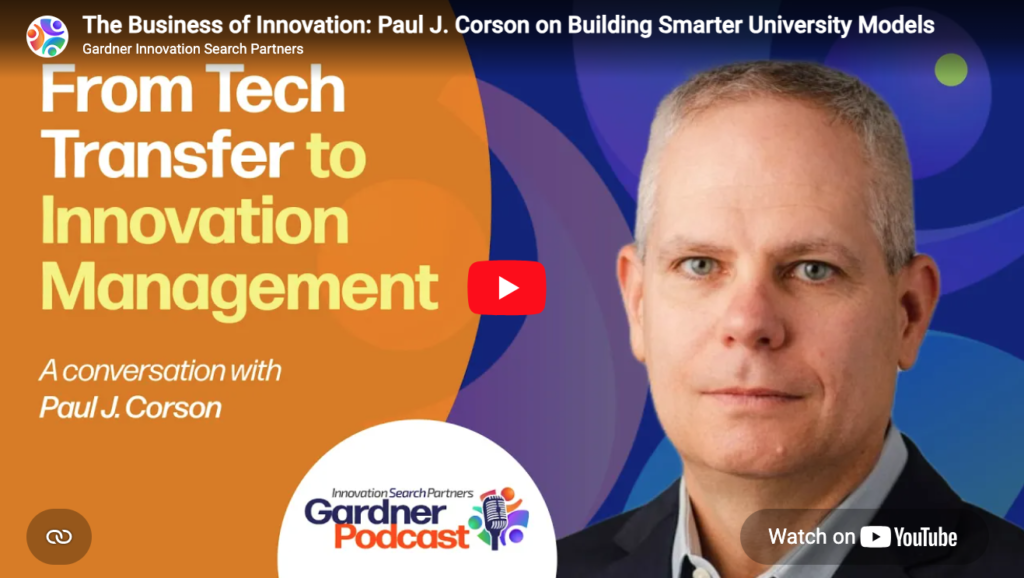
Universities have long been engines of discovery, but in today’s rapidly shifting global landscape, the way they move innovation from lab to market is under more scrutiny than ever. In this podcast episode, provided in partnership with Gardner Innovation Search Partners, host Quentin Thomas sat down with Paul J. Corson, Chief Innovation and Entrepreneurship Officer at the University of Texas Arlington, to explore how U.S. universities can—and must—rethink their business models to thrive.
Drawing on a career that spans corporate, government, NGO, and academic roles across the globe, Corson offered a candid look at why traditional technology transfer approaches may no longer suffice—and what needs to change.
From Accidental Paths to Purposeful Impact
Corson’s own journey is a testament to the unpredictable nature of career paths in innovation. Like many, he didn’t set out with a grand plan; instead, he followed opportunities wherever they led—whether that meant working in Armenia and Georgia in the 1990s or learning about people during night shifts making donuts. This openness to new experiences, he suggests, is crucial for leaders seeking to build resilient regional economies and foster tech-based entrepreneurship.
“My favorite thing is to experience something new. As long as I’m constantly stimulated, bombarded by new situations, that’s when it’s a favorite.”
– Paul J. Corson
The Tech Transfer Status Quo: What’s Holding Us Back?
For decades, university tech transfer has largely followed a predictable script: a faculty member invents something, the tech transfer office (TTO) tries to protect it (often via patents), and then shops it around for a licensee. But Corson argues this approach is fundamentally misaligned with how successful innovation happens in the real world.
Inventor-Driven, Not Market-Driven – Most university inventions are developed without a clear sense of market need or customer demand. This “push” model often leads to limited commercial success.
Resource Constraints – TTOs typically operate with tight budgets, forcing tough decisions about which inventions to protect and promote.
Misaligned Incentives – The traditional focus on patents and licenses doesn’t always reflect the broader societal impact universities aspire to achieve.
A New Model: The Business of Innovation Management
Corson advocates for a shift from “technology transfer” to “innovation management.” This means:
Starting with the Market – Like successful corporations, universities should begin by understanding real-world problems and market needs, then guide research and invention toward those targets.
Engaging Stakeholders Early – By collaborating with industry, investors, and entrepreneurs from the outset, universities can better align research with commercial opportunities.
Motivating Faculty the Right Way – Not all faculty are driven by the same motivations. Some are passionate about pure science; others want to see their work change lives. Recognizing and supporting both is key.
“We talk about maximizing the societal benefit of research. More and more, faculty want to see their life’s work benefit society in a tangible way.”
– Paul J. Corson
Why This Shift Matters
The imperative for change isn’t just academic. As regions seek to grow high-value economies, universities play a pivotal role. But to remain resilient and relevant, institutions must:
Adapt to Regional Needs – Every region has unique assets and aspirations. Universities should tailor their innovation strategies accordingly.
Build Sustainable Business Models – Relying solely on patents and licenses is no longer enough. Diversifying revenue streams and measuring impact more broadly is essential.
Foster a Culture of Collaboration – Breaking down silos between academia and industry—and within universities themselves—can unlock new opportunities for growth and impact.
Key Takeaways for University Innovation Leaders
Question the Status Quo – Is your tech transfer office truly market-driven, or just following tradition?
Engage Stakeholders – Build relationships with industry, investors, and the community to shape research agendas.
Recognize Diverse Motivations – Support faculty whether they’re driven by scientific curiosity or a desire for societal impact.
Measure What Matters – Go beyond patents and licenses—track real-world outcomes and regional economic growth.
UI Collab is a consulting and talent solutions firm focused on advancing university–industry collaboration. We offer executive search services to help organizations across academia, industry, and government build high-performing teams that drive research, partnerships, and commercialization forward.
Keep an eye on our Open Jobs; you never know when something will come along that fits your qualifications and expertise! Search our open job listings.
Interested in our executive recruiting solutions? Our expert consultants are skilled at working with teams to define role scope, align stakeholder expectations, and manage a structured search process designed to identify candidates positioned to strengthen research translation and ecosystem performance. Let’s work together!
This information has been provided in partnership with Gardner Innovation Search Partners. For more, explore our UI Pulse archives and follow us on social media.
Full Transcript
Quentin Thomas (Host): Hello and welcome to the Gardner Innovation Search Partners podcast. On this show, we sit down with the brilliant minds guiding the amazing work being performed at universities across the globe. I’m your host, Quentin Thomas, and today I’m excited to be here with Paul Corson, Chief Innovation and Entrepreneurship Officer at the University of Texas Arlington. Paul’s career spans across the public and private sectors, NGOs, and higher education in the United States, Europe, Latin America, Middle East, and Asia. And I’m excited to be talking with him today about how US universities can transform their business model to succeed in this rapidly shifting global landscape. Paul, welcome to the show.
So to hop into it, you have a very diverse background from corporate, government, academia. How did you get to where you are now?
Paul J. Corson: Thank you, Quentin.
Very haphazardly. I could say probably not unlike a lot of high school graduates who went to college because that’s what people did and that’s what you had to do to get a job. I went to college, changed my major from physics to Russian studies, and then wasn’t even sure what I’d do coming out of undergraduate. So I went and got a graduate degree in Russian studies, still wasn’t sure what I was going to do.
But I knew I wanted to be overseas. So I took the first job that would send me to a Russian-speaking country. It just happened to be Armenia and Georgia. I went to two countries in the mid-nineties, just as things were really changing dynamically. And that set in process a career that 30 years on looks like it could have been planned, but there was no planning. I very much just took the job everyone wanted in the place no one wanted to be, or went to the place everyone wanted to be and took a job that no one else wanted. And so in retrospect, what it’s come to look like is I’ve had a very deliberate career in trying to figure out how to build regional economies, often through tech-based entrepreneurship. But that was not by design.
Quentin Thomas: Interesting. You know, I completely get that. When I graduated from college, I was not sure what I was going to do, so I got a graduate degree because I wasn’t sure what I wanted to do yet. And actually that one sent me to Japan, so I did get sent overseas too, and that was my first time.
Paul J. Corson: And probably the best time of your life. Every job since that has probably had to measure to that first job overseas kind of thing.
Quentin Thomas: Yeah, I guess you could say that. So throughout your journey, because you’ve been to many different places and different roles, what have you learned about regional economic development?
Paul J. Corson: People like to say that phrase, “if you’ve seen one, you’ve seen one.” And I think when it comes to regional economic development, that doesn’t necessarily apply. We also have in the United States where everything has to be some “something dot O” version of Silicon Valley or Boston.
There are very distinctive characteristics, personality traits of regions all over the country and all over the world. There’s no denying that. But I also see very distinct similarities in regions. People are people wherever we go. And the economy is the economy wherever we go. I forget who it was that said, “Capitalism is the worst economy except for all the other types.”
And we in the United States very much have this idea that we need to continue to grow, grow, grow and grow through consumerism. But I distill it down to regions really need to understand what they want to be. Do they want to be high job growth, high wage, high value creation regions? Often that comes with traffic. Often that comes with urbanization. Often that comes with challenges that blur what it means to have been that region historically.
So whenever I get engaged, the first question I always tend to ask is, “What does this region want to be that’s different from what this region is now?” And then distilling down from there, there are very distinct characteristics and steps that a region can take to grow.
Quentin Thomas: Yeah. That’s interesting. When you were saying everywhere there’s people and in all these situations, you’re dealing with people and needing to understand those people in those regions as well too. It just reminded me of something on another podcast that we produce. We had Mayor Andre Dickens as the guest for someone else’s podcast and he was saying just in kind of dealing with people, “People are always people-ing,” you know?
And just a side question too, what’s been your favorite place to work in or your favorite region to be in?
Paul J. Corson: It’s, I typically say all the time, I don’t have favorites. My favorite thing is to experience something. And so as long as I am constantly stimulated, bombarded by new situations, that’s when it’s a favorite. When that ends, then I get a little bit bored and I want to move on to the next.
I can honestly say my favorite job I ever had was working the night shift making donuts. And I learned a lot about people and I learned a lot about the pace of a region by what happens after everybody goes to bed. One of the favorite cities that I’ve ever been to is Istanbul. And it was just that constant bombardment of new sensory stimulations.
And the other thing I really like is a challenge. So I’m much more comfortable going into a region that is on the cusp or verge of something, a region that’s at an inflection point, a region that says we want to grow and might not know what that means. I love that situation. I love trying to figure out how to put all the puzzle pieces together, as opposed to going into a region that’s mature, stable, and is sort of growth based on what we have versus growth based on what we aspire to be.
Quentin Thomas: Yeah, wow, that’s pretty cool. I didn’t know that you worked on Night Shift making donuts before, so that’s also really neat. Did you get tired of eating donuts at some point, or do you still like them?
Paul J. Corson: I love donuts. I limited myself to one when I showed up and one when I left.
Quentin Thomas: Nice. Smart move. So in all these things you’ve experienced, the places you’ve been, the things you’ve been involved in, and all that you’ve learned – how have what you’ve learned along your journey related to your thoughts about tech transfer? And actually, even before you answer that, do you even call it technology transfer?
Paul J. Corson: I don’t. I think that we can only be where we are having come from where we’ve been. And so I have the utmost respect for the people who pioneered the industry, the job of tech transfer. We can’t create new unless we have a foundation upon which to build. And so that idea of how do we, from 1980, when Bayh-Dole was passed, how do we take all of that incredible science? How do we take that wonderful technology? And how do we use it to create new products and services, new industries? How do we use it to innovate? We couldn’t be where we are now without having the 40 years of history of Bayh-Dole, 45 years, and sort of the 50 years of tech transfer.
I do think, though, that tech transfer typically focuses on: we have an inventor who invents often without a lot of market experience or market knowledge. They’re pursuing science the way universities have pursued science and education for the benefit of humanity. And then that gets handed off to a tech transfer office and that tech transfer office has to decide usually with a limited budget, some exceptions, bigger offices, bigger budgets, but without too many exceptions.
How do I try and protect this from the standpoint of a patent with a limited budget and limited knowledge? And so we get limited protection. And then we say, who wants to license my IP? That to me is the wrong approach. One of my good friends always says, “Paul, you need to eat some of your own dog food.” And that own dog food is teaching entrepreneurs, don’t create your company. Don’t invest in creating a product until you know there’s a customer for it.
So in the university sense, we’re creating a product, IP, without actually knowing who’s our customer and what our customer actually wants. And if we flip that on its head and take the advice that we give to those entrepreneurs, then we can go out to the investors. We can go out to the entrepreneurs. We can go out to industry. Generally speaking, they’re very willing to tell us what they’re interested in, what they’re investing in, what they see as the future.
And if we bring that knowledge back, I’ve found that faculty members are often very willing to pursue research that has more of a commercial application if they know what the application is. To just say, that’s not good enough, obviously I can understand why faculty would get upset or frustrated or annoyed or say, “Well, that’s what my grant’s for.” But if we work with faculty and say, here’s where the market is, here’s an idea for a solution to a problem that already exists – if we know that problem and they can figure out that solution, they still get the joy of inventing. They still get the joy of doing something new. They still get the joy of figuring out something no one else has ever figured out, but they’re doing it in a way that I can then help bring their creative genius to reality by getting it into a company, a product or a service.
So we talk about that as the business of innovation management as opposed to the act of transferring technology.
Quentin Thomas: Yeah, I mean, that’s great. And yeah, I definitely want to go into why that matters. You know, it’s interesting because what you’re describing is exactly how corporations do it, right? They look at what’s the problem out there that needs to be solved, what’s the market saying, and then they’ll design and develop around that, whatever their solution is. But we’ve been doing this technology transfer for decades now where it’s kind of like, whatever that researcher invented, let’s just see what kind of protection we can get and get it out there.
Before why it’s important – why do you think that we’ve been doing it this way and we haven’t already made this shift that you’re talking about?
Paul J. Corson: Again, there are good reasons for why things have progressed the way they have. One of those things is, what is the main purpose of a university? Is the purpose of a university to create knowledge? Is it to educate the workforce of tomorrow? Is it to build the economies of tomorrow? Is it to create knowledge, to pursue research?
So one is, the purpose of a university has evolved over time, especially in the United States, as the United States has evolved. And as time passes, we evolve more rapidly. And so it’s hard to take an institution that’s been around for thousands of years, maybe not thousands, maybe a thousand years, to take that institution and ask it to turn on a dime. Universities aren’t known as hotbeds of innovation and entrepreneurship. And that’s a good thing.
We have that idea of academic freedom. We have that idea of knowledge creation for the purpose of creating knowledge. And when someone comes in and says, “Yeah, that’s all good, but now you have to do something else” and that something else you have to do is business, I can understand why people think that impinges on academic freedom. I can understand why that might impinge on the purpose, the role, the value within a university.
I like to talk to faculty from the standpoint of what motivates them. There are some who will always say, “I’m just motivated by the science.” But there are a lot of other folks who say, “I’m motivated by seeing what I’ve dedicated my life to benefiting someone else other than simply them reading it in a book or in a paper. I want to see my life’s pursuit benefit society in a different way.”
That’s how we talk about what my center’s mission is – to maximize the societal benefit of research conducted at a university. And so having those conversations, understanding what motivates faculty – is it just you want to explore? Is it just you want to think? Or is it that you want to see people’s lives improve because of what you are able to create? More and more it’s that. And so more and more we’re having to shift from just that idea of “I have a patent, let me see if anybody wants it,” to “I want to benefit society, let me figure out how to do that.”
Quentin Thomas: Yeah, man, what you said about understanding what motivates them. I feel like that’s applicable not just in what we’re talking about right now, but in any form of leadership role. You’re talking about something that’s very important in understanding what motivates, because it’s not bad if it’s just purely they are motivated by the science. It’s not bad if it’s that they want to impact society.
It’s great, you know, but yeah, being able to tap into that and understand and being able to help them achieve that and still either one of those, whether it’s purely the science, whether it’s the seeing their life’s work, having an impact in their community, whether that’s, you know, the state, the country, the world. Both of those are applicable to what you’re talking about, like with this new business model.
So just coming to that question that you are getting to of why it’s important. I want to ask, like what why is that this shift important and also kind of tagging onto that, who might this be applicable to as well?
Paul J. Corson: So this circles back on where we started, which is how every region is different and what motivates the region to grow and the role of the university in that region. And then how do we create a sustainable or a resilient, maybe the right word is a resilient business model for a university given its role in a region.
So doubling back for just a second. Even though every region is different, I think there are four underlying types of capital that are vital to the growth, the development, the expansion, wealth creation for a community, for a region. And you’ll notice I don’t talk about ecosystems. I think the word ecosystem has been bastardized in so many different ways. And now it means nothing because it means everything to everyone.
At the heart of it, we have a community and that community has to rally around a vision for the growth, the development, the changes in that region. That’s where the idiosyncratic character becomes so important. But we have these four types of capital:
There’s human capital. People have to do the jobs. There’s intellectual capital. We have to innovate based on something. There’s physical capital. We need the roads, bridges, schools, but we also need the wet labs and the office space and the incubators and all of that. And then there’s financial capital. We need the money to invest.
And so when we think of a region in terms of those four types of capital, the university gets asked to do all of that for all things. We’re often the biggest employer. We’re often the biggest producer of workforce, we’re often the creator of intellectual capital, but not just the intellectual capital, but then the startups. But the startups are too risky. And so we have to invest in the startups, we have to build buildings, we have to be all four of those types of capital in a region. And we have to do it in every idiosyncratic region. That’s just too much.
And I think that’s led to a situation where universities have had to go down so many rabbit holes that resiliency in its business model becomes really challenging to pull off. And so, especially in this era right now, where government funding has been – the paradigm for government funding has changed very rapidly, more rapidly than most universities can adjust to. Corporations are faced with challenges, especially in a changing environment.
What is that role of a university? Does it have to plug every hole? And if it does have to plug every hole, how can it do that? It can’t. The numbers don’t work out from a dollars and cents standpoint.
So stepping back and thinking about the university acting more as a catalyst, there are regional champions who can rally behind and push a vision for regional economic development. But the university may not be the best organization to be at the forefront of that. And to be honest, elected officials may not be the best people to be at the forefront of that. It’s so much more complicated.
And so if the universities can step back and say, we’re really good in this region, at this institution of doing this – maybe it’s workforce and science. Maybe it’s science and startups. Maybe it’s providing the physical infrastructure and we have an alumni base that can provide the capital. But figuring out what the university can excel at in terms of those four types of capital, finding champions that can garner the interest, support and time and participation of all those others in the region, and then building out that innovation agenda, which then a policy platform can come in behind and support.
I think the role of the university maybe in some areas can advance and expand and maybe in some other areas might retract a little bit, but that doesn’t mean in retracting that it’s a zero sum game. It means that it just provides a vacancy for someone else to fill.
Quentin Thomas: Hmm, yeah. You know, that’s interesting because I’m even just thinking about universities now and I’m not going to say I’m an expert in university history or the evolution of universities, but even just some of the things I’ve seen just in my career, it seems like the role of the university has continued to expand and expand and expand.
One of the things, for example, like the number of innovation hubs and things like that that have come up. And like you’re saying, it’s like universities are sort of expected to fill in these gaps. And one of the things you’re talking about, I imagine that if, particularly for regions where there are multiple universities, what you’re talking about will be a pretty good model for even universities to be able to collaborate together where they have strengths and others may have weaknesses and then kind of coming together and complementing each other more as opposed to competing for whatever resources in these different areas.
Paul J. Corson: It really is fascinating. We just spent a couple of days at UT Arlington talking about what it means to be an R1 university, what it means to be a comprehensive research university, what it means to try and create new majors to meet the demands of society and the rapidly evolving demands of society and what that means for older majors.
I was asked by our department of linguistics to give a talk on career day because they said, “We’ve got a lot of students who are pursuing degrees that have a linguistic component, but their parents don’t necessarily see the value in them. And so how do we give the students talking points to help their parents see that there’s value in this?”
And for me, my degree is not necessarily linguistics. It’s more international relations, but Russian, the Russian language was a huge component, about a quarter of my classes. And by learning the construct of Russian, it helped me understand some of the ways that folks who speak Russian think – whether our society dictates the way of the construct of our language or vice versa. If we understand the construct of languages, we understand so much about societies. And so I will take a linguistics major who shows an ability to learn science just as I’ll take a scientist who shows the ability to think creatively and in a way where they can learn language. We can’t divorce them from each other.
But then how does the university do all of this? If there are multiple universities in a region and we’re all fighting to be R1 and we’re all fighting to be the biggest R1 and we’re all fighting to be the most comprehensive and we’re all fighting to have the best computer science department and we’re all fighting for grants, then we’re just fighting. And that’s self-defeating.
Quentin Thomas: Yeah, yeah, absolutely. Absolutely. Well, this has been great. As we wrap up, one last question. What advice would you give to, let’s say, maybe a vice president of research or researchers or even others in these ecosystems on how to move forward right now? Like what that next step looks like?
Paul J. Corson: If we could all develop one skill, and I’m going way out on a limb here, this is beyond anything that I’ve ever studied – the concept of empathy, the concept of understanding, putting ourselves in someone else’s position and understanding the external forces and the internal motivations that drive people. If we can do that, not just as individuals, as researchers, as administrators in universities, if we can do that as human beings, I think we can step back from a lot of this, whether we call it conflict or we call it brinkmanship, we call it whatever.
We need each other to advance, to thrive. And so as a VP for research at a research university, it’s not just about STEM. It’s not just about the arts. It’s not just about the education. It’s not just about the commercialization. It’s not just about the economic development. It’s not just workforce. It’s about all of that.
When we think of that, we get to the genuine definition of an ecosystem, which is how animate beings engage with the inanimate environment around them. If we call our regional development sort of that inanimate object and we are all the animated beings, if we understand each other better, we can then capitalize on the collaborations.
Quentin Thomas: I love it. I love it. Paul, it’s been wonderful talking to you. Thanks for coming on to the Gardner Innovation Search Partners podcast. And I hope that I get to chat with you some more. This is great.
Paul J. Corson: We’d love to see you in Arlington, that’s for sure.
Quentin Thomas: Okay, absolutely, yeah, you can count on it. And yeah, thank you. And to everyone tuning in right now, thanks for tuning into the Gardner Innovation Search Partners podcast. Have a wonderful day.